Fertility & Reproductive Health
Fertility starts well before a positive test.
Thinking ahead, trying to conceive, pregnancy and postpartum.
Eggs and sperm take around three months to develop. What happens in that window can influence what happens next.
ThriveHer helps you understand what to look at first, which questions to ask, and what can change.

ThriveCode
There's an order to healing.
Stop guessing. Start with what matters first.
See how it works →What women are often told
Relax and keep trying. That isn't a plan.
Many women are told to wait twelve months before anyone looks further. That's four full development cycles of eggs and sperm left to chance.
And it's rarely just you. Male factors contribute to around half of couples' difficulties conceiving, yet your partner is often the last to be assessed.
ThriveCode
This is where the order matters.
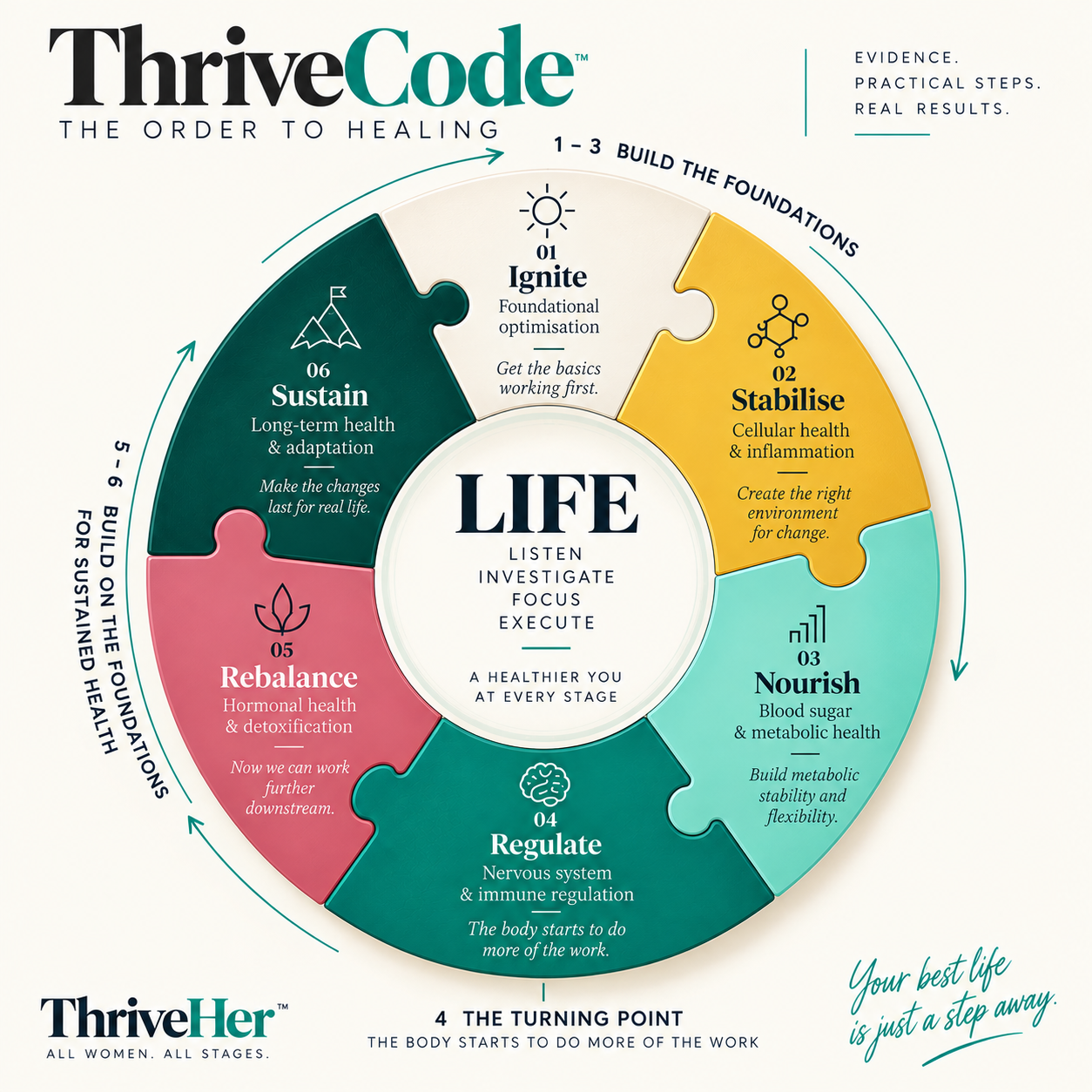
Most health advice starts with the thing that's bothering you. ThriveCode asks a different question: what needs to be working first?
We build the foundations before asking the more complex systems to regulate. By Phase 4, something important starts to change. The body begins doing more of the work itself.
Six phases.
One deliberate order.
What we cover
You've been handed all of it. Half of it isn't yours.
Fertility advice is almost always aimed at women, and most of the worry lands on you. ThriveCode works through your foundations first, inflammation, blood sugar, nutrient status and stress, and makes room for your partner's. Where it helps, we measure rather than guess.
1. Before you try
The three-month window
Eggs and sperm develop over roughly three months before conception. That makes the months before you start trying the most useful time to prepare, not the months after it hasn't happened.
Key ThriveCode phase: Ignite
2. His half
Not just your job
Research links sperm quality, including DNA integrity, with how well an embryo develops, and some studies link it with miscarriage. The encouraging part: sperm renew roughly every three months, so his changes can show up quickly.
Key ThriveCode phase: Stabilise
3. Pregnancy and beyond
Building another human
Pregnancy draws heavily on your nutrient stores. Recent research links a mother's fatty acid balance in late pregnancy with her baby's early development. And after birth, many women are still depleted a year later.
Key ThriveCode phase: Nourish
When it isn't happening
Unexplained isn't the same as nothing to find.
Unexplained infertility and recurrent miscarriage are common diagnoses. Often they mean the standard tests came back normal, not that nothing is going on.
This is where looking at inflammation and immune function, and at your partner too, changes the conversation.
ThriveHer looks at what the standard workup can miss:
- Your partner assessed too, not just you
- Inflammation and immune function
- Thyroid, iron and blood sugar
- Fatty acid balance and nutrient status
- Stress, sleep and the nervous system
We work alongside your GP, fertility specialist or IVF clinic, not instead of them. In ThriveCode, the foundations come first: Ignite and Stabilise.
Choose how much support you want.
Start free with Discover. Get the complete ThriveHer experience with Elevate. Or choose Catalyst when you want ThriveHer plus personalised 1:1 clinical care.
Discover
Your way into ThriveHer
Start here. Stay connected, learn something useful and see what ThriveHer is all about.
- ✓ ThriveHer podcast, blog and new-content notifications
- ✓ Free ThriveHer challenges
- ✓ Invitations to free and ticketed ThriveHer events
- ✓ Selected bonus videos, education and resources from time to time
Elevate
per month
Everything ThriveHer has to offer, in one membership.
- ✓ Daily Clinical Focus: a 1–2 minute video from Rochelle, delivered straight to the app
- ✓ Live Q&A with Rochelle every two weeks
- ✓ Quarterly Masterclasses, including replays
- ✓ All ThriveHer programmes, the complete video library and new content as it's added
- ✓ ThriveHer Tribe community, member challenges and access to Rochelle through comments and community conversations
- ✓ VIP invitations to live events plus 20% off private consultations
Catalyst
per month
Everything in Elevate, with ongoing 1:1 clinical care from Rochelle built in.
- ✓ Everything in Elevate
- ✓ Weekly clinical check-ins with Rochelle, usually 10–15 minutes
- ✓ Longer consultations available when clinically needed
- ✓ Personalised clinical care plan and ongoing review
- ✓ Private, secure clinical messaging between consultations
- ✓ Full clinical care, including test interpretation and individual recommendations where appropriate
Joining us from overseas? ThriveHer is Australian, so all memberships are priced in AUD. If you're in the US, Canada, UK or New Zealand, your bank will simply convert the payment into your local currency. And depending on the exchange rate, that can make ThriveHer even better value.
Catalyst membership includes clinical care. Pathology testing, supplements, prescriptions and other third-party costs are not included in the membership fee.

Your health will change
ThriveHer is built to change with it.
You might be here because something doesn't feel right. You might be planning a pregnancy, navigating changing hormones, thinking about the years ahead, or simply wanting to stay well.
You don't need to know exactly where to begin. That's what ThriveHer is here for.
Start with Discover for free, or choose the level of support that makes sense for you now.