
Why the Glass of Wine That Used to Relax You No Longer Works
You know the ritual. Hard day. Glass of wine. The specific kind of exhale that comes with it.
It used to work. You would feel the tension ease, sleep reasonably well, and move on with your life.
Now something has shifted. The edge comes off briefly and then something else arrives in its place. You sleep, but you wake at 3am with your heart running. You feel more anxious the next morning than you did before you started. The week after a social event feels disproportionately hard. What used to be a reliable way to decompress now seems to compound the very thing you were trying to manage.
You have probably wondered whether you are imagining it. Whether your tolerance has just dropped. Whether this is simply what getting older feels like.
It is none of those things. There is a specific clinical mechanism that explains exactly why alcohol behaves differently in a perimenopausal body. And once you understand it, the pattern you have been noticing makes complete sense.
It Was Never Really Relaxing You
This is the part that tends to land hardest.
Alcohol is a central nervous system depressant. It does reduce subjective feelings of tension. That initial sense of ease is real, and it is not imaginary. But what it is doing underneath that feeling is a different matter entirely.
In the hours after drinking, typically in the back half of the night while you are asleep, alcohol triggers a cortisol release. Your nervous system, which should be in its deepest recovery window, instead mounts a stress response. Cortisol rises. Adrenaline follows. Your body is activated at exactly the point it most needs to be at rest.
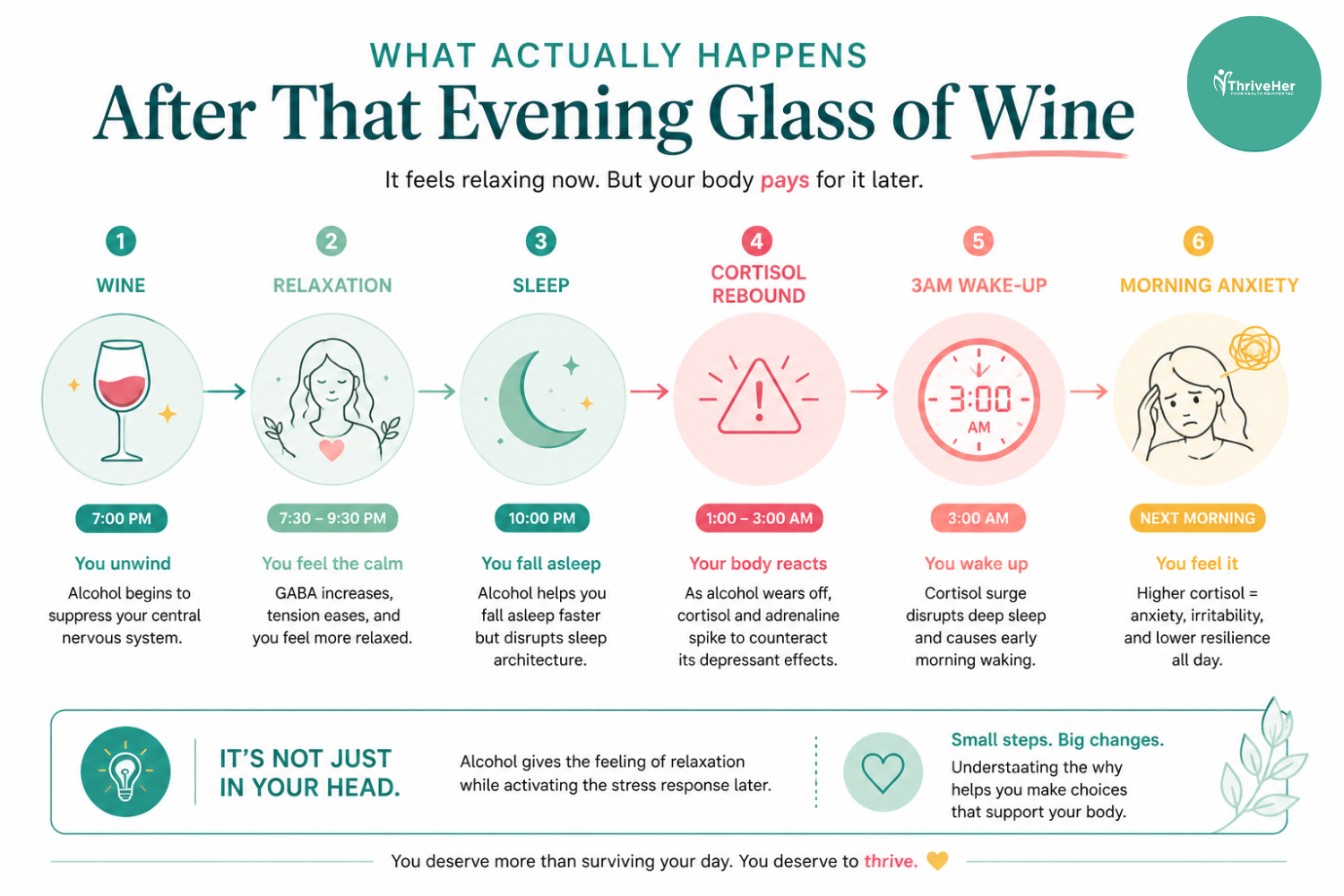
This is cortisol rebound. And it is the clinical explanation for the 3am wake, the racing heart, the low-grade dread that greets you in the morning. Your body is not reacting to the day ahead. It is still responding to the drink from the night before.
Alcohol gives you the feeling of relaxation while quietly activating the stress response underneath it. You pay for the shortcut in the second half of the night.
Why Perimenopause Makes This So Much More Noticeable
This mechanism is not new. Cortisol rebound from alcohol happens at any age. What changes in perimenopause is how hard your system gets hit by it.
In the years before perimenopause, oestrogen was quietly buffering your stress response. It modulated cortisol output. It helped your nervous system return to baseline after activation. You probably never noticed it doing this because it was working well enough that you did not need to.
As oestrogen declines in perimenopause, that buffer reduces. The HPA axis, your body's central stress command system, becomes more reactive. Recovery between stressors takes longer. And the cortisol spike that alcohol was always triggering overnight now lands in a system that has far less capacity to absorb and recover from it.
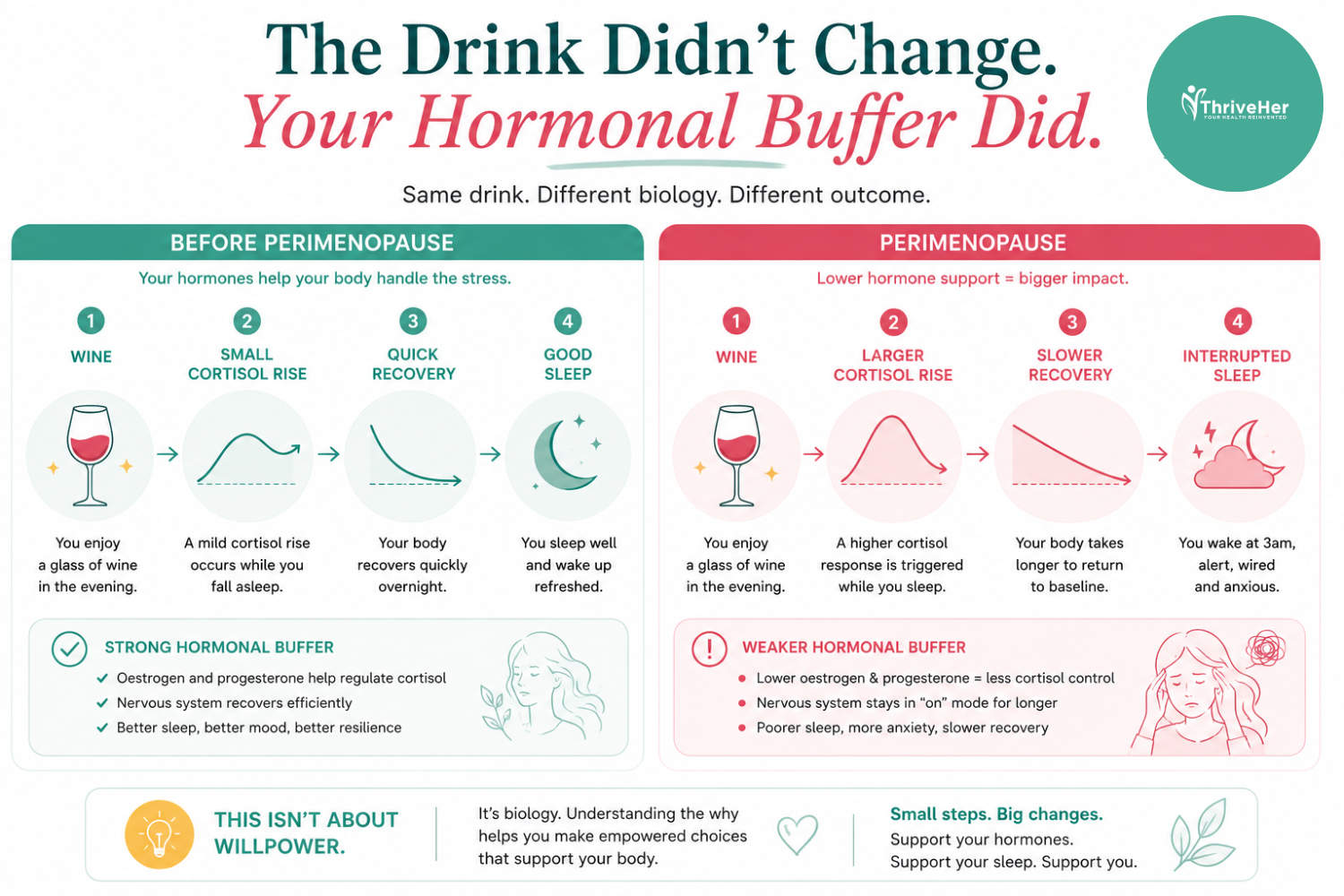
This is why the same amount of alcohol that you have always drunk is now producing a response that feels completely different. The drink has not changed. Your hormonal buffer has.
Add to that the progesterone decline that happens in parallel. Progesterone has a natural calming effect on the nervous system. It acts on the same receptors that alcohol targets. As progesterone falls, women often reach for something external to replace that sense of ease at the end of the day. Alcohol is the most socially available option. But unlike progesterone, it does not produce genuine nervous system recovery. It mimics the first part of the effect while undermining everything that would actually restore you overnight.
The Morning After Is Data, Not Weakness
The anxiety that follows a night of drinking is one of the most commonly reported and least clinically explained experiences women describe in perimenopause. It gets attributed to personality, to stress levels, to getting older. Rarely does anyone explain the cortisol mechanism behind it.
If you have noticed that you feel more anxious, more flat, or more emotionally fragile the day after drinking than the evening before you started, that is not a character trait. It is physiological. Your cortisol has spiked and dropped in a compressed window overnight.
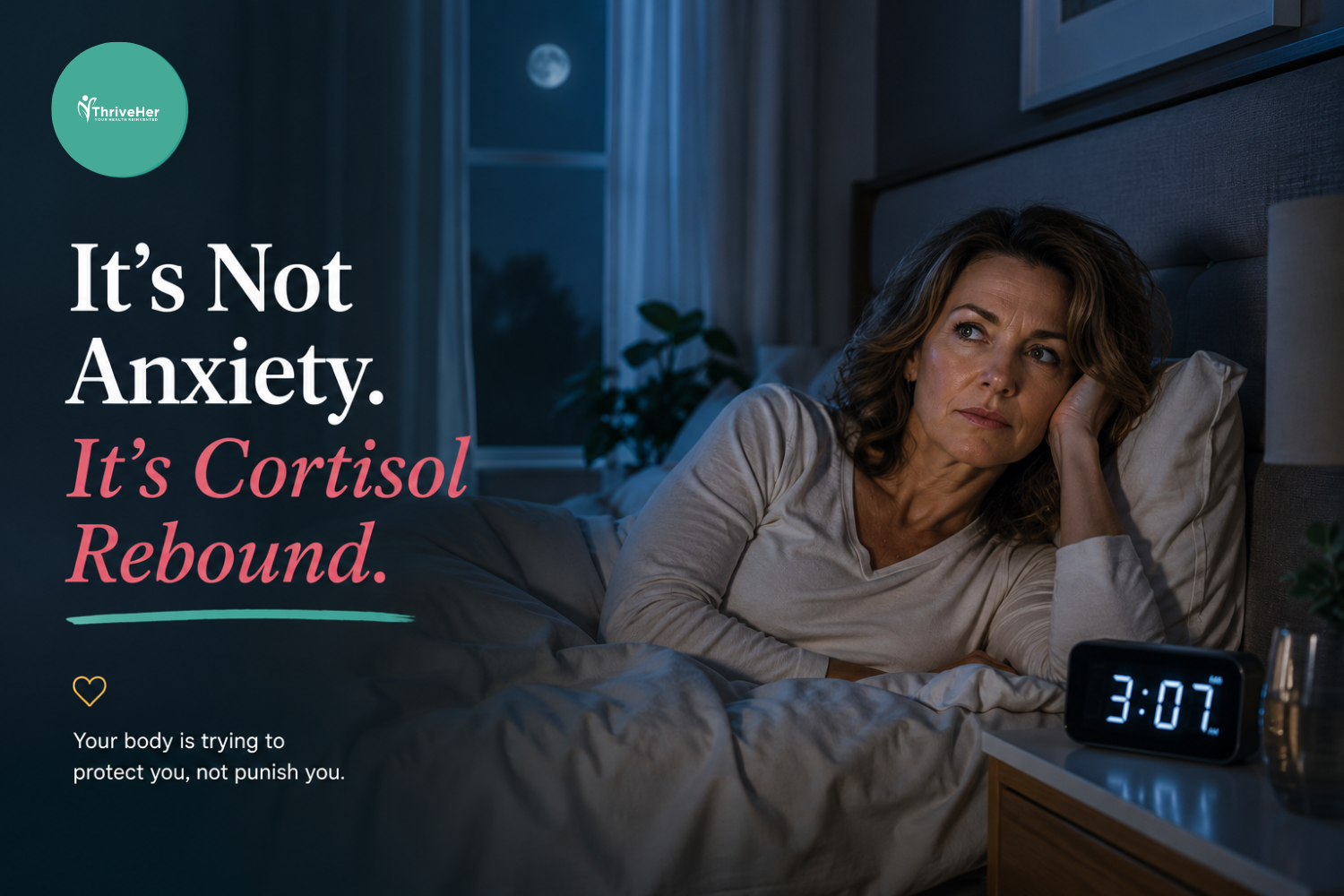
Your nervous system is running a deficit. Your body is communicating something specific, and what it is communicating is that the cost of that drink was higher than it appeared.
That is not a moral observation. It is a clinical one. And knowing the difference matters because it changes the question from what is wrong with me to what is my body actually telling me.
The Clinical Conversation Most Women Never Get
This is one mechanism of several that Rochelle Waite, Australia's only Naturopath holding Masters Degrees in Immunology (Autoimmunity), Women's Health Medicine, and Reproductive Medicine, covers in Episode 29 of the ThriveHer Podcast.
The episode goes beyond cortisol rebound into what alcohol actually does to oestrogen metabolism and liver function during perimenopause, what it does to sleep architecture in a body already dealing with progesterone decline, and why the things women are noticing in their bodies after drinking are not a coincidence. Four mechanisms. No moralising.
If the pattern has been showing up in your life and nobody has given you a clinical explanation for it, this is that conversation.
Listen here: ThriveHer Podcast Episode 29.
What Your Body Is Actually Asking For
The glass of wine at the end of a hard day is not just a drink. It is a signal, a ritual, a permission to finally stop. That need is real, and it deserves to be taken seriously.
The clinical question is whether alcohol is actually meeting that need or just approximating it cheaply. If what your body needs is for its nervous system to downregulate, alcohol is giving you a shortcut that costs you the real thing. True nervous system recovery happens through the sleep stages, which alcohol suppresses and disrupts the cortisol regulation.

If you want to understand what genuine nervous system recovery looks like in a perimenopausal body, and what it takes to move the physiology in the right direction one day at a time, that work happens inside the ThriveHer Tribe. Every weekday, a Daily Clinical NUDGE lands directly in your WhatsApp. Not a wellness tip. A clinical micro-action grounded in exactly this kind of framework. Elevate membership is $47/month. Head to thriveher.vip.
Your body noticed before you did. That is not anxiety. That is information.
Frequently Asked Questions
Why do I feel more anxious after drinking than before I started?
This is cortisol rebound. Alcohol suppresses the nervous system initially, creating a subjective sense of relaxation. In the hours that follow, typically during the second half of sleep, the body mounts a compensatory stress response. Cortisol and adrenaline rise. In perimenopausal women, whose stress response is already less buffered due to oestrogen decline, this rebound tends to be more pronounced and the recovery window longer.
Has my alcohol tolerance actually dropped in perimenopause?
Tolerance in the traditional sense is not the main driver here. The more accurate explanation is that the hormonal buffer that was moderating your stress response has reduced. Oestrogen modulates cortisol and supports nervous system recovery. As oestrogen declines in perimenopause, the same amount of alcohol produces a larger downstream effect on your stress physiology. It is a hormonal shift, not a tolerance change.
Why does alcohol affect sleep so much more now than it used to?
Several mechanisms converge in perimenopause. Progesterone, which has a natural sedative effect and supports sleep onset, has declined. Cortisol patterns are more easily disrupted. And alcohol suppresses REM sleep, which is the stage most concentrated in the second half of the night and most critical for hormonal recovery and emotional regulation. The result is that alcohol's impact on sleep architecture is more disruptive in a perimenopausal body than it was at an earlier stage of life.