Why Stress Feels So Much Harder in Perimenopause (It Is Not in Your Head)
You have handled hard things your whole life. Careers, kids, relationships, loss. You are not someone who falls apart under pressure.
So why does everything feel so much heavier now?

A difficult conversation that you would have shaken off in your thirties now sits with you for days. A disrupted night wipes out the whole week. A stressful afternoon, and you are still wired at midnight, staring at the ceiling, mind refusing to stop.
The stress did not get worse. Your capacity to absorb it changed. And there is a specific clinical reason why.
Most women never hear this explanation. It does not show up in standard blood tests. It rarely comes up in a GP appointment. And yet it is one of the most significant, most overlooked shifts in perimenopause.
It comes down to one thing: oestrogen was managing your stress response. And now it is not.
Oestrogen Was Doing Something Your Body Took for Granted
For most of your adult life, oestrogen has been quietly working in the background of your stress response.
It modulates cortisol output. It supports the production and activity of serotonin, which is central to mood stability and emotional regulation. It helps your nervous system downregulate after a period of activation, so that once the stressor passes, you actually come back down.
You probably never noticed any of this. That is exactly the point. The buffer was working so well that you had no reason to notice it.
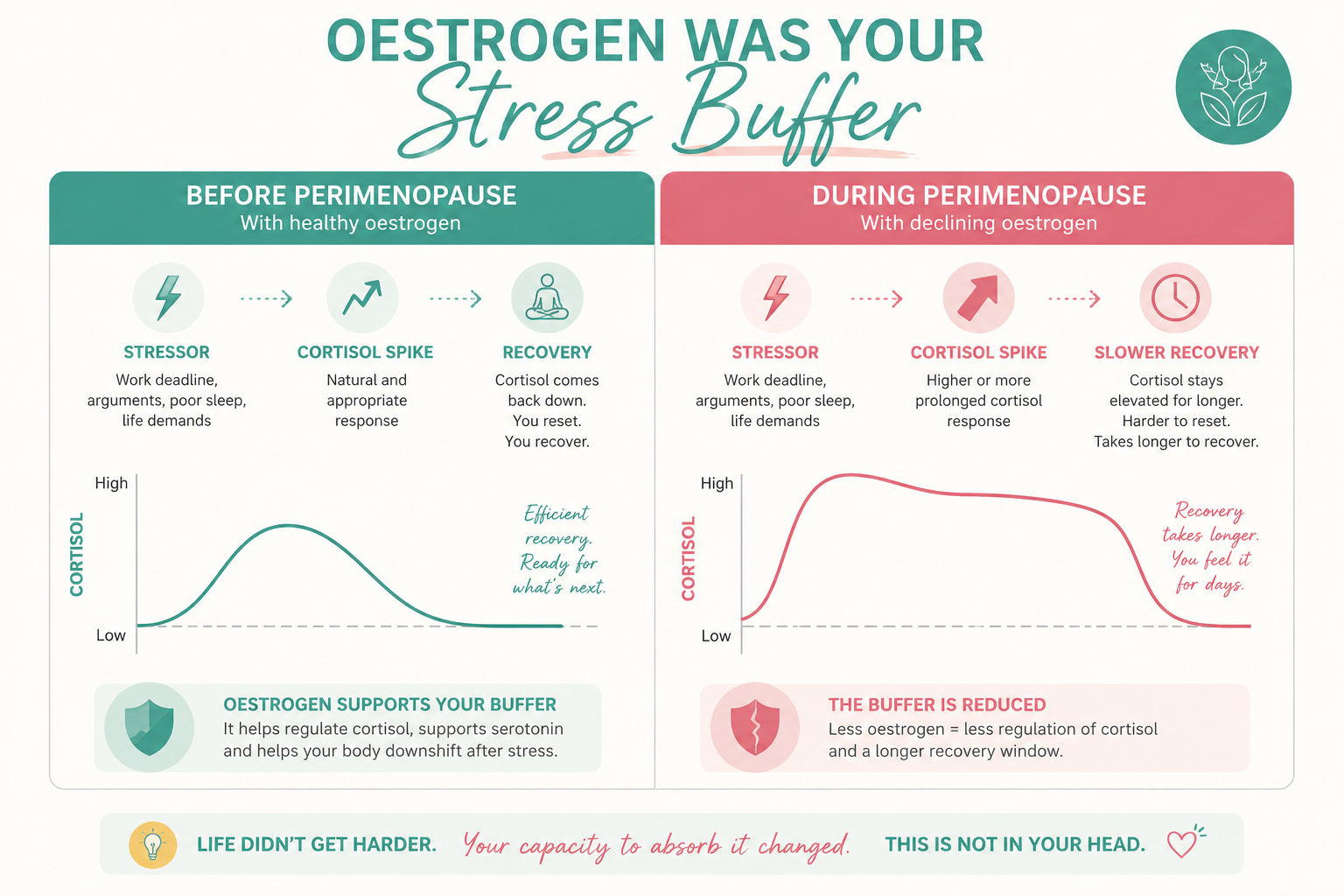
Now, in perimenopause, oestrogen levels begin to fluctuate and decline. That buffer reduces. And the stress response that oestrogen was quietly keeping in check starts to run without the same regulation.
The stress load has not increased. Your capacity to absorb it has. That is not a personal failing. That is a hormonal shift with a clinical explanation.
What Changes When the Buffer Reduces
This is where it gets specific, and where a lot of women have a moment of recognition.
Your stress response is governed by the HPA axis, the hypothalamic-pituitary-adrenal axis. When oestrogen is present at healthy levels, it helps keep that axis regulated. Cortisol rises when it needs to and comes back down when the threat has passed. Recovery is relatively efficient.
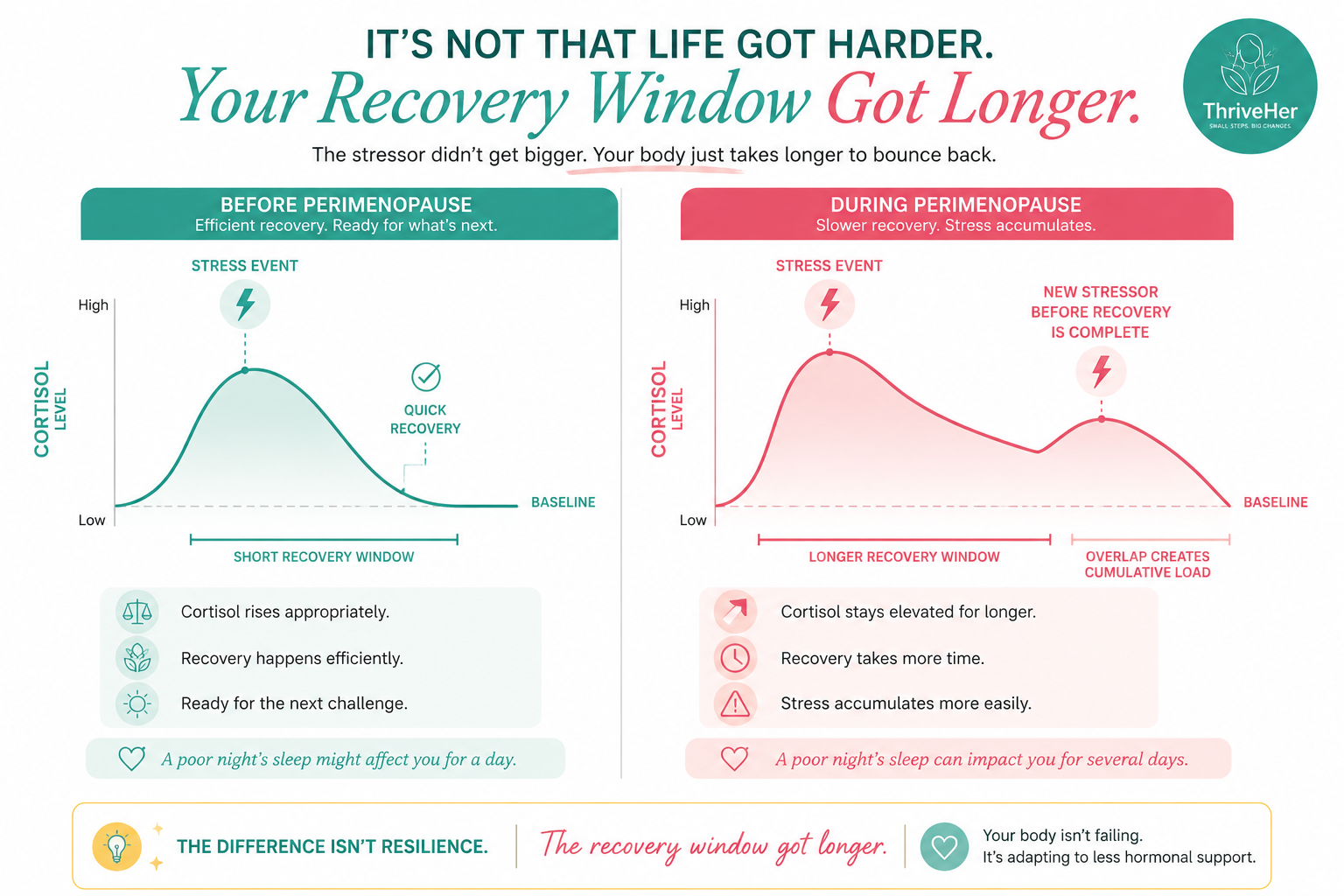
When oestrogen declines, that regulatory influence reduces. The HPA axis can become more reactive. Cortisol patterns that were once predictable become erratic. And the recovery window between stressors gets longer.
This is why one glass of wine now wrecks your sleep when it never used to. Why a late night cost three days of recovery instead of one. Why you can feel genuinely overwhelmed by things that would have barely registered five years ago.
You are not becoming fragile. Your hormonal buffer is no longer doing what it used to do. Those are different things. And they require a completely different response.
Why This Gets Mistaken for Anxiety, Burnout or Just Getting Older
The symptoms that come from a dysregulated stress response in perimenopause look remarkably similar to generalised anxiety. Heightened reactivity. Trouble sleeping. Difficulty recovering from emotional demands. A persistent sense of being on edge or running close to capacity.
Which is why so many women in this stage of life end up with an anxiety diagnosis, an antidepressant prescription, or both. Not because the clinician is wrong to take the symptoms seriously. But because the hormonal driver is not being investigated.
It also gets written off as burnout, which is partially accurate but clinically incomplete. And it gets dismissed as a normal part of getting older, which is the most common and most damaging explanation of all.
It is not normal. It is not inevitable. And it is not simply stress.
It is a physiological shift with a clinical picture. And that clinical picture has a name.
The Clinical Picture Your GP Probably Has Not Named
Rochelle Waite, Australia's only Naturopath holding Masters Degrees in Immunology (Autoimmunity), Women's Health Medicine, and Reproductive Medicine, covers this in full in Episode 28 of the ThriveHer Podcast.
She draws the clinical distinction between being stressed and being physiologically depleted, maps exactly what HPA axis dysregulation looks like across daily life, and explains why the standard advice women receive for this, exercise more, stress less, try magnesium, misses the actual picture entirely.
If you have been noticing that stress lands differently now and nobody has been able to tell you why, this episode is the clinical explanation you have not been given.
Listen here: ThriveHer Podcast Episode 28.
This Is Not the New Normal
Understanding that oestrogen was regulating your stress response changes the question entirely. It is no longer: what is wrong with me? It is: what does my body need now that it is operating with less hormonal support?
That is a clinical question. And it has clinical answers.
The ThriveHer Tribe exists for exactly this. Every weekday, a Daily Clinical NUDGE lands in your WhatsApp. Not a wellness tip. A clinical micro-action grounded in where your physiology actually is right now. Elevate membership is $47/month. Head to thriveher.vip.
Your body is not falling apart. It is running with less support than it has ever had. There is a difference. And it matters.
Frequently Asked Questions
Does oestrogen actually affect the stress response?
Yes. Oestrogen has a regulatory effect on the HPA axis, the body's central stress response system. It influences cortisol output, supports serotonin activity, and helps the nervous system return to baseline after periods of activation. This is well established in neuroendocrinology research, though it rarely makes it into standard clinical conversations.
Why do I feel so anxious in perimenopause when I never used to?
Heightened anxiety in perimenopause is often driven by the withdrawal of oestrogen's buffering effect on the stress response, rather than a new anxiety disorder. The HPA axis becomes more reactive when oestrogen declines. This can present as persistent low-grade anxiety, emotional overwhelm, or difficulty recovering from stress. It is worth distinguishing this from primary anxiety because the clinical approach is different.
Is perimenopause stress response the same as adrenal fatigue?
They are related but not the same. Adrenal fatigue is not a recognised clinical diagnosis. HPA axis dysregulation, which is the more accurate clinical description of what occurs when the stress response becomes dysregulated over time, is distinct from simply having a hormonal shift in perimenopause. In practice, many women in perimenopause experience both: the oestrogen buffer reducing at the same time as a stress response system that has been running hard for years begins to lose its rhythm.
Rochelle Waite is Australia's only Naturopath holding Masters Degrees in Immunology (Autoimmunity), Women's Health Medicine, and Reproductive Medicine. ThriveHer is a clinician-led women's health platform. thriveher.vip